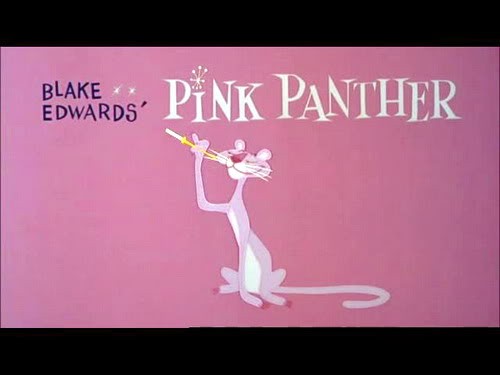
This is not a translation or an interpretation. These materials are something not yet defined. A thought, maybe. It’s the use of the materials. The thought that through some kind of reflection, something is found about desire and technology. The Pink Panther has some kind of negative approach to things. The silent acts that reflect on the beat of the music. Tickled Pink is a way to think.
In this episode of the original Pink Panther series, the Pink Panther sees some kids passing by skating having a lot of fun. For a second there, the Panther wants the skates, but lets it go. But, as it renounce to it, it suddenly finds a Fairy Godmother. It is granted three wishes. But the wishes won’t operate in the fashion of wish or desire. The wish, that materializes as a replication of the thought of skates is a pair of skates. Old fashioned four wheel skates. Then, the Panther falls, obviously, and the Godmother completes the wish: the skates will move by themselves. The Panther in the floor grabbing firmly to the tree, gets ripped and ejected from the possession of the desire in no particular direction to go across the city and more particularly across a window. Desire put his way won’t be nothing but a motor of motion, the materialization becomes a powerful undirected motion that breaks through the consistency of expected position. No one can expect to be motionless in desire. There is no possession of such element. Desire possesses you. Breaking the glass is an important element because this experience brings the motion not only as a hurtful experience, that needs to stump against the materiality of existence, but as a breakthrough motion. There will all kind of situations that seem to contain and stop the skating panther, our consideration of a singularity in motion, but all that will happen in this situations to change directions.
Afterwards, the panther will go up and down, showing no particular direction. It will go up buildings, down the sewer, into a car-wash and other places. All doomed to become effectual, within the Panther that learns that wants to get rid of desire, that it doesn’t brings simple joy. An important process of desire is trying to get rid of it. Not in the sense of stoic practice, but a more primal act of suppressing it by ignoring it. Why did someone would wanted what can materially impact existence? And at this point we can understand that desire is not limited to a mental state. It won’t be just something that comes and goes away from the head as some kind of bothersome thought, but that with arbitrary materialization will become something like the skates. It is not skates that the Panther desires but the wish to materialize what can be grasped and translated like an object. Not only as an act of appropriation but as an act of creation.
But there is no limit in what we can refer as transit of desire just like that. There are next steps to the material presentation of bestowed desire. It is not just a determination that brings to the motion, but it translates in some kind of propellent for rational and legislated action. The Panther will soak the skates with white paint, and while the motion keeps on, the arbitrary movement will start to establish patterns of movement, the Panther will draw traffic lanes. So, it will be dividing the traffic and conducting machines, lifeless and desireless cars along the world. It will take them out of the places into the barren country, making new destinations. Cars through the hills and outside the highways. But this also ends in a powerful way, a dead end. The Motion will be stuck and loss it way giving capacity when stuck. Desire as a way to direct others is not a mechanism for freedom but a dangerous drive to a dead end, where the cars will stomp after the Panther, but it gets alive. To think that desire fucks you up while riding you and riding the others, only enough to let you alive is a very important possibility. Is not a conceptual precision, but an implication for thought. Desire won’t kill you, will only take you to the point of no return, and the need to hide it. The Pink animal tries to put bandages over its skates. To control it, but desire breaks free of the bindings set and starts motions again.
The last element of near death becomes three parts. First, the Panther will go through a car factory and get a carcass so it feels protected. The mechanisation of desire. A construction where the material appearance of desire is complemented by a thought. But no, this construction doesn’t makes this materialization just a car, but skates and a carcass build a prototype of the problem of technology, its add up, seems to be another kind of production of desire. Then, the process of motion takes it to confrontation against two trucks going in the opposite direction in a one way street. This is not a killer action, either. The encounter will end with a very flat Pink Panther that has been compressed between the vehicles to barely alive. Here it can be said: there is no protection of desire and the ways that existence is driven and transformed through it, doesn’t correspond to rational expecations. The dimensionality of protection against desire will only flatten out a never dead body, covered with a carcass. Get it! It’s so funny.
The second element is when the Panther gets inside the subway and faces imminent dead against the train. This, in fact is before getting the carcass. But there, the materialization of desire operates as a tool. An adaptation to technological conditions to be able to transfer desire to survival. The skates over the rails, allow the Panther to escape certain dead. As close as the Panther has been placed to dead, desire can be used in a wrongful way as a tool of escape against the crushing motion of modern power and institutions. The limit is quite blunt and dangerous. It is not an idea of tools as a happy machine that can be used for pleasure, but as a dispositive of salvage.
Finally, the third term is being confronted with raw animality. The skates take the Panther to the zoo. This never stopping desire confronts the Panther with a cage labeled Gorilla and with an Elephant. He gets punched by a fist from the caged and battered by a happy elephant turned mad. This is the moment where the raw fleshy existence has taken the body of the Panther to a point where it can get hit without suffering pain. Desire has brought the Panther to the position to confront a notion of caged nature. A delimitation of the act of killing, posed over the caged animals, that make it just another confrontation for this desire that has been now, covered and confronted by its own material transformation into technology. The motion is so powerful here, desire against raw animal existence, it can work to stand this human/panther condition. No that it stops being the animal, but that as part of a motion it can’t be caged or destroyed any longer.
Here is where the tale comes to an end. The Pink Panther comes to the park where he found the Godmother and it tells: you have two more wishes. First, and beware the Hegelian position of this. The desire needs to be crossed out. The same image that first made the skates materialize now with a cross makes them disappear. The material objects can be separated of the act of desire. But this action is not enough. Yes the materialization is gone and walking without being pulled by such desire is possible, but now, revenge is at hand; the immediate third wish is the Fairy Godmother to be carried by the skates. The provider of the mechanical element has to retributed. The final position of this conception of desire is that the possible material existence of such mobility is procured on others, not as a way of surrendering desire from ourselves, but to make them but a perverse action to watch work with all its chaotic and uncontrollable power.
This way to loose desire is a way to manage our own in capability and worrying limit to the human experience. Maybe when Walter Benjamin pictures the empoverishment of human experience crossed with the technification of experience, it is to think the relinquishment of desire as an expectation of it as a display. But, what is the limit of this practice. Not stop to watch, but to consider how can we modify our way to turn from wish to desire and materiality, as well as the production of materiality as a technical development from desire, not as motionless spectators but as producers. The big question would be ¿how to think today beyond the perversity of the production of technologies?
 Speaking Jabberwocky!
Leave a comment